Monday, 16 November 2009

Doing Energy Saving Properly


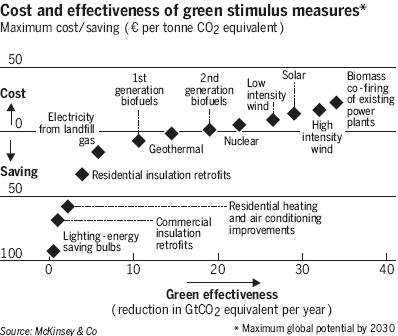
I stumbled upon a very simple chart today, one that gives us an interesting analysis of energy saving and the best way to do it. It's a chart published in the Financial Times to go with an article called "Advantages of Frugal Fuel". It by McKinsey & Co and shows the green effectiveness of a number of common green energy technologies. Any technology below the zero line shows a technology that not only reduces CO2 emissions, but will also save you more money than it costs over its lifetime.

It clearly illustrates that using energy efficient light bulbs and insulating walls is the best, cheapest and most cost effective "green stimulus measures". Forget the solar panels, the wind-power or even geo-thermal. Just change your light bulbs and insulate your walls and you're doing far better than investing in any other technologies.

Should we be spending massive amounts of money on new power stations, wind-farms or just ensuring that we all get more energy efficient by changing our filament light bulbs and insulating our walls. Amazingly, the money should be going on bulbs and insulation! And almost astonishingly, the EU recognises this; Andris Piebalgs, the commissioner in charge of energy said "Energy efficiency is the cheapest and most effective way to reduce energy policy risks".

So, for all of you planning green data-centres, virtualisation or thin-client desktop rollouts think again, you should actually be just planning to swap your light bulbs, insulate your walls and make all your friends do the same. I'm kind of joking, but it does make it very clear that you shouldn't be taking such measures for altruistic reasons alone, it needs to significantly improve the company's bottom line!

Thursday, 12 November 2009

Cloud? What Cloud?!

On Wednesday evening I was at a conference/dinner. The prescribed topic of conversation was how to reduce costs and complexity within technology. This is central to what I'm working on at the moment, is an interesting topic to debate and worth finding out what other senior IT professionals think, particularly during this economic period. And to make it very interesting, Paul Colby, British Airways' CIO was there to talk about how he had managed costs down and reduced complexity over the last 8 years. All good, nothing bad

But, why do these things always degenerate in to a discussion about "The Cloud". Every time I've been to one of these events, and I do mean every time, whatever the official topic of conversation we end up arguing about "The Cloud", what it is and whether we need it. Why are we so obsessed? It's all marketing fluff anyway so why can't we leave it alone?

I think I know: it's because no-one really knows what the cloud actually is, whether it's useful, cost effective, safe, capable, reliable or anything else. It's another technical emporer's new clothes and that makes it a gift for the salespeople and consultants! A few years back all the alleged Cloud functionality was already available, just defined separately: Software as a Service, Hosted servers (dedicated or shared), GoogleMail/GoogleApps, Grid Computing, Utility Computing, etc. etc. But now for some reason it's all got bundled up in this Cloud reference and people think we've got a new technology. Well, no we haven't, it's the emporer's new clothes, it really is. And so we argue and we argue and we argue.

Unfortunately for the CTO or IT Director, whilst we argue and ponder and disagree on what the cloud is, the salespeople and consultancies gather around our CEOs like bees round a honeypot and suddenly it doesn't matter what we think about the cloud any more because you're on the back-foot watching your grip on the IT strategy disappear as the CEO derails it with consultant-led fanciful ideas of saving millions by investing in the cloud.

Now, I never like being on the back-foot and I sure don't like surprises either from my team or from the board so this where we need to proactively manage upwards. Some time back I blogged about the CEO needing to trust the CTO and this is a great example of where that trust is needed. If the CEO trusts the CTO to keep him informed about emerging technologies and trends then salespeople and consultants will be redirected to the CTO rather than be listened to because the CEO knows the CTO will be on top of it already.

Building that trust and ensuring the CEO knows you're on top of it needs to be a priority. Briefing the CEO regularly on new technology or the trend-de-jour within the IT world is pretty important. By briefing the CEO, you're more likely to keep things on track, reduce the number of surprises coming from above and have more time to properly decide whether to invest in these new-fangles technologies as part of the IT strategy rather than as a reactive requirement from the CEO which is never a good place to be.

In the meantime, if you fancy a lively discussion on the smoke and mirrors that is the cloud, give me a shout

Saturday, 31 October 2009

A Recommendation

This is completely off-topic, it's not about leadership or technology or anything like that, it's actually a recommendation. As a busy leader it's often very easy to forget to take time out and relax and I am notoriously rubbish at taking holiday, I mean real holiday - somewhere foreign in a hotel - because for me holiday means "not at work", but for my wife (a full time, fantastic mother and housewife) taking holiday at home doesn't work as holiday for her. So, after a lot of negotiation we agreed to properly go away leaving the boys in charge of my mother.

A 3rd party recommendation isn't always a reliable one, but we took a flyer and booked 5 nights in a boutique hotel in Marrakech and boy did it pay off. Dar Zermora really is a boutique hotel with 2 suites, a chalet and 3 other bedrooms, that's it and that's what's so fabulous about it. It's a few kilometers out of Marrakech, but the taxi-transfer was there waiting at the airport. Our suite was spacious and cosy at the same time. The hotel is sited in just over three acres of tranquil, calm and lush grounds and has a private house feeling. The gardens were right next to our patio and the decent sized pool just another few yards away. Breakfast on the patio, lunch and dinner in an outside dining area. It was just so easy to relax that it took me completely by surprise, we lounged by the pool, swam, read books, soaked up the sun (in mid October) and slept. We wanted for nothing!

Yes, Marrakech with the souks, madina and many sights and restaurants was there and we went a couple of times, but relaxation was what this holiday was about and the hotel gave it to us in buckets and we didn't waste a moment! Even the thunderstorm on the last afternoon just seemed to fit in and enhance the holiday rather than detract from it. On our final morning in the taxi back to the airport, the sad bit was knowing that we were going to be back in London in a few hours time - the flight is only around 3 hours - and that we'd be driving back round the M25 in rush-hour. Ah well, at least now we know that we have a place to go if we need real, unadulterated r&r, although it's not suitable for kids so we'll need to work on my Mum again if we're to get there again any time soon.

Regardless, if you want some genuine time-out that really gives you the relaxation you need, no-one should pass up the opportunity to stay at Dar Zermora.

Saturday, 26 September 2009

ByteNight is here again!

On Friday, 2nd October, ByteNight comes round again. This is the second year I've done ByteNight and the second time that I've been in a team that's successfully raised £5k. Woohoo & Phew!!

Actually this year, raising the money was tougher than ever, mostly due to the economic climate and people being less willing to part with their cash. Regardless, we got lucky - we had a load of redundant IT kit when we moved out of an office earlier this year and selling it to people in the Technology team gave us a real boost towards our target.

Obviously I'd be delighted if we raised more money, so if you'd like to donate, please go to our Justgiving website - click on the Donate button on the Justgiving widget on the right hand side of this blog.

Here's hoping that it'll be dry, last year it was dry, but very, very cold. However, that's preferable to rain!

£5k enables Action for Children to achieve a lot, and even in this economic climate I understand that ByteNight is on track to beat previous records with the regional events being significantly larger than last year. Last year's ByteNight raised more than £450k altogether and with very low overheads the vast majority of money goes straight to Action for Children initiatives.

Anyway, please keep fingers crossed for decent weather!!

Saturday, 5 September 2009

A Conundrum

I have a conundrum at the moment, I'm doing a lot of stuff that's incredibly interesting at work and in many ways I would love to blog about it and talk about the issues, difficulties, excitement, challenges and outcomes but this blog is in the public domain and the vast majority of what I'm doing will have an impact on people within my company. There are also commercial sensitivities that need to be taken in to account.

That impact is not necessarily going to be seen as positive by everyone that it affects. Whilst I believe that all I'm doing will be very positive for the business in the long run I need to have a duty of care to those who may or may not be involved and read posts I put on this blog.

So, it is interesting times at work and maybe at some point in the future I'll blog about them, but for now I'll be having a think about other topics that I can blog on rather than what I am dealing with at work.

At the moment I'm working on a presentation for a conference in September on being a great leader in challenging times. When that's finished, I'll post something along those lines. In the meantime, please excuse the lower than normal levels of blogging!

Tuesday, 9 June 2009

Team Morale

I was coming back from the supermarket at lunchtime and overhead the following conversation between a young dad and his grizzling toddler daughter: "What's wrong? We're supposed to be having fun, man, what are you crying for? Why can't we just have fun?" The joys of having uncommunicative off-spring with unfathomable agendas. I knew exactly how he felt in more ways than one. I have young boys myself and I've always been amazed at how fragile their mood is, but it started me thinking about team morale and his exasperated questions sounded very familiar in the work sense too. Team morale is as fragile as a three-year-old's, but unlike my sons, team morale cannot be fixed through the application of a strawberry ice-cream.

"Why can't we just enjoy what we're doing?" will be a phrase often thought, if not expressed out loud by many a leader struggling to understand why morale is low. Unfortunately it's not usually one thing or another that is afflicting the whole team, but a whole spectrum of little issues associated with individuals that manifests themselves across the whole team killing off morale.

Individual morale issues can be addressed, but one sure-fire way to kill off morale across the team is to keep people in the dark about change. In today's environment where change is the norm and job security is at an all time low people really want to know what's going to happen and yet it may be impossible to provide the detail that satisfies the craving for knowledge. Unfortunately whilst it is understandable that leaders want to only convey finalised decisions the rumour mill will mean that those kept in the dark will have already made 2 and 2 equal 5 and their conclusions will be spreading like wild-fire through the organisation. This is not good. So, why not treat people like adults and tell people about on-going decision-making?

Giving people the opportunity to know about incomplete decisions sounds risky, but surely it must be a positive thing in the long run. Most people like to know what's going to happen or may happen and will grab any passing snippet of information they can in an attempt to rationalise their future. By involving them in the change process, rumour and conjecture will be removed and whether the messages are positive or negative at least people know where they stand.

Recently I witnessed this working when a new senior manager bluntly told a team what they already knew, but hadn't been officially told. Everyone was releaved, everyone felt better, even though the message was not very positive at least they now knew. They could then get on with their work knowing their future even though in 12 months time the system they were working on would be no more the communication gave them an opportunity to make sound decisions for themselves on their own future. On this occasion it worked. On another occasion it didn't - promises were made about a new office which never came to fruitition, but it only didn't work because no-one was brave enough to stand up and give an adequate explanation of why the promises never came to fruititon - leadership were scared to get up in front of people and say "we screwed up".

If leaders communicate on-going change, then the teams need to get on board too. There needs to be acknowledgement that communicating decisions or strategy prior to being finalised means they are at risk of changing. The leaders need to be prepared to stand up and explain reasons for change and the teams themselves need to be prepared to hear these changes in direction and cope, to do anything else will ensure morale will be as bad as ever.

At a senior leadership level, ambiguity and uncertainty are ever present and it's a world we're all familiar with and yet at the grass roots level, there is a preference for a black and white world with no ambiguity. It's the leaders job to ensure that the amibiguity s/he lives with every day is translated in to something that the teams themselves can cope with and understand. Treating people like mushrooms is not an option so somehow we need to communicate these ambiguities in ways that people will feel comfortable with. As yet, I don't think I have a complete answer, it's a work in progress, but I have found that more communication is better than less and listening carefully to what the teams have to say is also important.

Oh, and one last thing: Never, ever view the budget line-item that provides pizza to the team once a month as optional, maybe the morale re-boot with food does still work as well on adults as with children!

Thursday, 28 May 2009

ByteNight 2009

ByteNight 2009 will launch on Tuesday 30th June. This year it will take place overnight on Friday 2nd October, nearly 400 IT professionals will be sleeping out under the stars in central London raising funds for Action for Children. I took part for the first time last year in a team pulled together by silicon.com (The Silicon Comrades) and between us we managed to raise around £7,000 with the whole event raising in excess of £450k. This year, I was asked to join the ByteNight board and I've also managed to persuade some of my work colleagues to join me in a team. We've just kicked off our fundraising efforts for this year, with the team aim of raising at least £5,000, but the overall aim is to exceed the last year's total.

I've added a widget on the side of my blog to show how well we're doing raising the cash, if you are reading this and feel you can help, just click here and give us some money. If you'd like to know more about ByteNight or even want to take part, then go and check out the website and also take a look at the Action for Children website too whilst you're at it.