Why does the best technician still frequently end up as the person promoted to run the team? I really would have thought we, as an industry, would have worked this one out by now and stopped this automatic process because the best techie is frequently by far the worst candidate for the job.
Most typically this can be seen in teams that are populated by uber-techies: network teams, Linux sysadmin teams, etc. The techies look upon the uber of uber-techies in the team as their silver-back gorilla. The senior management team spot it and reward that uberuber-techie by following the Peter Principle and promoting to incompetence. Indeed it's a double wammy because the promotion also reduces team productivity: the uberuber-techie is no longer doing uberuber-techie things, instead they are stuck in a world of people management and task allocation, sitting in management meetings bored out of their brains and generally not very happy with the result.
How wrong can it get, literally brimming with wrongability.
If I've not seen a spark of leadership capability, and frequently I don't, bringing in an outsider to manage the team is by far the best option. The only problem with this method is that the techie team usually fails to realise what's good for them and resent the imposition of someone with a management/leadership skill-set having had mis-guided expectations of promotion from within. So, if you do bring in an outsider, you MUST have methods in place to recognise the silver-back in your organisation and use techniques other than promotion to leadership to give them their continued growth outlet.
I've got one chap who's very happy being an uberuber-techie and just wanted to choose his own job title and get good salary increase each year. Well, that's an easy one - done and done! Others have aspiration to leadership, but have yet to demonstrate the skills, again that's not a problem. Provide them with opportunities to see if they really do have those latent skills - this can be done in minor, reasonably safe ways, for instance by providing project management opportunities or sending them on a leadership course or whatever. Finally if a non-management route to increased responsibilities is available then many will recognise that uberuber-tech is what they're good at and give up on the idea of leadership.
Simples!
Saturday, 20 February 2010


Friday, 29 January 2010
The end of the Office?
The recent bad weather has again given my team the opportunity to test our remote access capabilities. Yet again we've proved that remote working works well for us. Just like in Feb 2009 we suffered no ill-effects from having half the team snow-bound - we had the tools in place to enable people to do their job remotely and everything continued as normal.
These enforced remote working periods have all been relatively short periods - mostly just a few days. Whilst I've said that we continued to function as normal, as the length of remote working increased the short-comings of our set up started to show. Right now, I don't believe it's ready for frequent or long periods of remote working and certainly not adequate for a permanent remote working solution.
It's not the tools that enable my team to do their job that are missing, it's the peripheral capabilities that you take for granted in an office environment. Most are based around the need to work with others and communicate and share information whether formally or informally.
For instance, how do you edit a document in a meeting with half the attendees working remotely? Yes, of course, you can use Webex and teleconferencing. It's all possible. But if you've not planned in advance it can be a bit of a nightmare - recently I attended a meeting where half the meeting time was used up whilst people joined the online and teleconferencing element. The inevitable rush through the document was anything but satisfactory.
People quickly miss the office interaction, casual conversation, walking around, impromptu brainstorming or whatever that can happen in the office environment to get things resolved. Remote working tends to introduce a formality that you just don't get in the office, it stifles many aspects of day-to-day office activities that are essential, but often taken for granted.
It also means that managers and leaders have to systematically alter the way they manage their people - they have to trust a great deal more and enhance performance management and measurement and get far better at consistent and regular communication - it's very easy to forget someone when they're working remotely and people can quickly become accustomed to doing the minimum to get along which would not be possible in the office and productivity slips away.
How to resolve this conundrum? Create and use an on-line virtual office. Your team can join it with their avatars and bobs-your-uncle, you've got your office environment back. You can achieve the social interaction and spontaneity that you get in the real office and resolve many of the issues described above. Once more you have an environment where people can interact spontaneously, managers can once more manage by walking around chatting with individuals more or less like they would in the office. It's obvious when someone's taken a lunch-break or in a meeting - they're not at their virtual desk, just like in the real-world office. Meetings can be held in virtual meeting rooms with virtual projectors sharing documents or presentations just like they would in the real world - no more long-winded sign-in processes, you just virtually walk in to the meeting room and get going and how wonderful, there's no limit on the number or size of meeting rooms!
There are a few of these types of environment on line, but I've yet to come across anyone who's actually used any of them and found it successful. We'll see, but surely this must be the way to go? How much could you save off the bottom line if you could close the vast majority of your office-space going on-line for the rest of it. How much travel would you save if all your meetings with clients were in the virtual office, plane rides to see the overseas offices would be a thing of the past, everyone could be in one "building" - no longer would teams have to be split over multiple locations. Taken up by the majority, this would decimate the office rental market, change the look of our cities forever, save companies millions, remove vast amounts of traffic from our roads and reduce everyone's carbon footprint... By that score, we should all start immediately. I for one am going to explore it further and see where it gets me...
These enforced remote working periods have all been relatively short periods - mostly just a few days. Whilst I've said that we continued to function as normal, as the length of remote working increased the short-comings of our set up started to show. Right now, I don't believe it's ready for frequent or long periods of remote working and certainly not adequate for a permanent remote working solution.
It's not the tools that enable my team to do their job that are missing, it's the peripheral capabilities that you take for granted in an office environment. Most are based around the need to work with others and communicate and share information whether formally or informally.
For instance, how do you edit a document in a meeting with half the attendees working remotely? Yes, of course, you can use Webex and teleconferencing. It's all possible. But if you've not planned in advance it can be a bit of a nightmare - recently I attended a meeting where half the meeting time was used up whilst people joined the online and teleconferencing element. The inevitable rush through the document was anything but satisfactory.
People quickly miss the office interaction, casual conversation, walking around, impromptu brainstorming or whatever that can happen in the office environment to get things resolved. Remote working tends to introduce a formality that you just don't get in the office, it stifles many aspects of day-to-day office activities that are essential, but often taken for granted.
It also means that managers and leaders have to systematically alter the way they manage their people - they have to trust a great deal more and enhance performance management and measurement and get far better at consistent and regular communication - it's very easy to forget someone when they're working remotely and people can quickly become accustomed to doing the minimum to get along which would not be possible in the office and productivity slips away.
How to resolve this conundrum? Create and use an on-line virtual office. Your team can join it with their avatars and bobs-your-uncle, you've got your office environment back. You can achieve the social interaction and spontaneity that you get in the real office and resolve many of the issues described above. Once more you have an environment where people can interact spontaneously, managers can once more manage by walking around chatting with individuals more or less like they would in the office. It's obvious when someone's taken a lunch-break or in a meeting - they're not at their virtual desk, just like in the real-world office. Meetings can be held in virtual meeting rooms with virtual projectors sharing documents or presentations just like they would in the real world - no more long-winded sign-in processes, you just virtually walk in to the meeting room and get going and how wonderful, there's no limit on the number or size of meeting rooms!
There are a few of these types of environment on line, but I've yet to come across anyone who's actually used any of them and found it successful. We'll see, but surely this must be the way to go? How much could you save off the bottom line if you could close the vast majority of your office-space going on-line for the rest of it. How much travel would you save if all your meetings with clients were in the virtual office, plane rides to see the overseas offices would be a thing of the past, everyone could be in one "building" - no longer would teams have to be split over multiple locations. Taken up by the majority, this would decimate the office rental market, change the look of our cities forever, save companies millions, remove vast amounts of traffic from our roads and reduce everyone's carbon footprint... By that score, we should all start immediately. I for one am going to explore it further and see where it gets me...
Wednesday, 27 January 2010
ISPs and the DEP
Rory Cellan-Jones blogs here about who's winning the file sharing war, there are some wide-ranging and sometimes wild comments following the blog itself. Personally, I come down on the side of Charles Dunstone, the traditional ISP provides the highway along which data passes, nothing more. If a customer is doing something that infringes someone's copyright, then it's between the copyright owner and the customer, not the ISP.
I'm also struggling to work out what this current proposal and activity will achieve except another round of technology escalation. Every time the record industry attempt to block, stall or stifle file sharing, the technically minded come up with a way round it and file sharing goes on as normal after a short hiatus. Eventually the peer-to-peer networks will become so sophisticated in their obfuscation techniques that not even the ISPs with their deep-packet inspection tools will know what is file sharing traffic and what isn't making it impossible to traffic shape or know when or how someone is infringing copyright.
Does a piece of technology exist that was supposed to protect a system, service, copyright or device that hasn't been broken? Blu-ray was supposed to be secure, but it's now possible to rip a Blu-ray disc, it's somewhat complex, but completely possible. Only yesterday there was news that the PS3 had been hacked. As long as the copyright owners continue on this escalation route, so will the hackers and crackers and it'll be the hackers and crackers that win, not the copyright owners. That is unless the copyright owners change their model.
Actually, let's be specific here, it's the corporate monolithic copyright owners that need to change, there are many private copyright owners, particularly in the music industry, who are coping quite happily within the file-sharing domain, in fact making a tidy living out of it simply because their overheads are much lower, they get a greater margin from their efforts, they're able to specifically target their market and they provide bespoke products for their market. In other words they're providing value add a price point and regularity that the corporate monoliths cannot hope to achieve. These artists may not be making millions, but they're certainly able to live off their artistic achievements as long as they don't rest on their laurels and expect a CD to do their work for them.
Considering how long this file-sharing "war" has been going on for, I'm amazed that the basic lessons still don't seem to have been learnt and the large corporate copyright owners continue to point the finger elsewhere rather than understand they have only themselves to blame.
I'm also struggling to work out what this current proposal and activity will achieve except another round of technology escalation. Every time the record industry attempt to block, stall or stifle file sharing, the technically minded come up with a way round it and file sharing goes on as normal after a short hiatus. Eventually the peer-to-peer networks will become so sophisticated in their obfuscation techniques that not even the ISPs with their deep-packet inspection tools will know what is file sharing traffic and what isn't making it impossible to traffic shape or know when or how someone is infringing copyright.
Does a piece of technology exist that was supposed to protect a system, service, copyright or device that hasn't been broken? Blu-ray was supposed to be secure, but it's now possible to rip a Blu-ray disc, it's somewhat complex, but completely possible. Only yesterday there was news that the PS3 had been hacked. As long as the copyright owners continue on this escalation route, so will the hackers and crackers and it'll be the hackers and crackers that win, not the copyright owners. That is unless the copyright owners change their model.
Actually, let's be specific here, it's the corporate monolithic copyright owners that need to change, there are many private copyright owners, particularly in the music industry, who are coping quite happily within the file-sharing domain, in fact making a tidy living out of it simply because their overheads are much lower, they get a greater margin from their efforts, they're able to specifically target their market and they provide bespoke products for their market. In other words they're providing value add a price point and regularity that the corporate monoliths cannot hope to achieve. These artists may not be making millions, but they're certainly able to live off their artistic achievements as long as they don't rest on their laurels and expect a CD to do their work for them.
Considering how long this file-sharing "war" has been going on for, I'm amazed that the basic lessons still don't seem to have been learnt and the large corporate copyright owners continue to point the finger elsewhere rather than understand they have only themselves to blame.
Saturday, 19 December 2009
A lesson in service
On Thursday night, my wife and I celebrated 15 years since our first date with by best-man and his girlfriend. We went to the Clarendon in Chandlers Cross, Hertfordshire, had a great time and experienced levels of service that are very rarely found and should be a lesson to everyone in a service industry, I'll explain...
We arrived early, but our table was free. The manager told us we were welcome to be seated and if we ordered immediately we'd be served quickly, but then he had a busy period of around 20mins after which at 8.30pm when we were supposed to sit down at our table it would be quiet again so we had the choice of either ordering immediately or waiting. We chose to wait. Fantastic just to be informed properly of our choices, I don't recall that ever happening before in a restaurant - the first example of great service.
Shortly after 8.30pm, we ordered and also talked to the waitress about wine. My friend had had a glass of house wine and commented how good it was. Our waitress agreed with us and told us about how much effort had gone in to getting a good house red and recommended we go with it. At £14.50 a bottle, we thought it worth the risk and it turned out to be a great decision. The second example of great example of customer service.
The food came promptly and was absolutely superb. I've never experienced a better Fois Gras nor Fillet Steak, the fat-chips were to die for and the cheese with eccles cakes was just divine. All washed down with more bottles of that really good house red.
Now, the third example of service pushed things through the roof, but it's worth providing some background: That night, the predicted snow came. When we got to the restaurant, it hadn't started, but by the time we left there was enough for it to screw up the roads. We had booked a taxi for 11pm, but it didn't arrive and on calling the taxi-firm I was informed there was no chance of a taxi. So, 5 miles from home, in a blizzard at 11pm with a baby-sitter at home looking after the my sons and the girls in shoes far from suitable for a long walk. This was a stressful moment...
So, there we were, the four of us, without a taxi and very few options. The manager and his staff had the time to think of a number of options for us, but we concluded that the simplest was to walk home. The staff produced spare shoes for the girls and we prepared to brave the snowy blast. Then one of the staff decided to really go that extra mile, literally. Jasmin decided to take us as near to home as she possible could in her Mini, it wasn't even on her way home and she had to return to the restaurant. The roads were now covered in compacted snow, the route home had hills and narrow back-roads, this was not going to be an easy journey, but Jasmin was game. Wow, what a fantastic offer, we accepted.
So, the journey home was easy at first, but then we took a wrong turning round which gave us our first "stuck in the snow for the night" scare, but we extricated ourselves. Then everything was ok until we hit the hill on the road up to the outskirts of the village. Everyone out of the car helping Jasmin get the car up the hill. With a few halts and scary skids we eventually got tho the top. Jasmin turned to go back to the restaurant via the M25 having done us the greatest service anyone could ever have done that night. She didn't have to, she didn't need to, but she did. What a staggeringly fantastic attitude, I'd have someone like that on my team any time and it should be an example to anyone who wants to understand what going the extra mile really means.
Thank you Jasmin, along with your restaurant you made our night. The walk across the common to home was done with high spirits and quite a bit of enjoyment and it was all because a some people went the extra mile. This is an example I shall use many times in the future when people ask what going the extra mile really means. Certainly my wife and I, my best-man and his girlfriend will always remember that night as a fantastic experience, but it could have had a very different outcome, but due to the wonderful service we received particularly in the face of adveristy, we will look back on the evening with great memories.
Thanks Jasmin!
Monday, 16 November 2009
Doing Energy Saving Properly
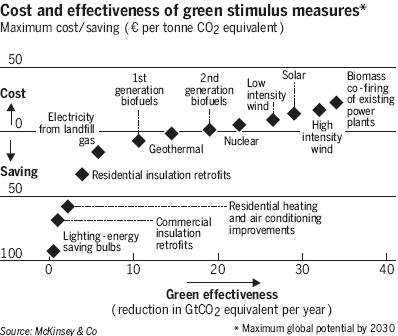
I stumbled upon a very simple chart today, one that gives us an interesting analysis of energy saving and the best way to do it. It's a chart published in the Financial Times to go with an article called "Advantages of Frugal Fuel". It by McKinsey & Co and shows the green effectiveness of a number of common green energy technologies. Any technology below the zero line shows a technology that not only reduces CO2 emissions, but will also save you more money than it costs over its lifetime.
It clearly illustrates that using energy efficient light bulbs and insulating walls is the best, cheapest and most cost effective "green stimulus measures". Forget the solar panels, the wind-power or even geo-thermal. Just change your light bulbs and insulate your walls and you're doing far better than investing in any other technologies.
Should we be spending massive amounts of money on new power stations, wind-farms or just ensuring that we all get more energy efficient by changing our filament light bulbs and insulating our walls. Amazingly, the money should be going on bulbs and insulation! And almost astonishingly, the EU recognises this; Andris Piebalgs, the commissioner in charge of energy said "Energy efficiency is the cheapest and most effective way to reduce energy policy risks".
So, for all of you planning green data-centres, virtualisation or thin-client desktop rollouts think again, you should actually be just planning to swap your light bulbs, insulate your walls and make all your friends do the same. I'm kind of joking, but it does make it very clear that you shouldn't be taking such measures for altruistic reasons alone, it needs to significantly improve the company's bottom line!
Thursday, 12 November 2009
Cloud? What Cloud?!
On Wednesday evening I was at a conference/dinner. The prescribed topic of conversation was how to reduce costs and complexity within technology. This is central to what I'm working on at the moment, is an interesting topic to debate and worth finding out what other senior IT professionals think, particularly during this economic period. And to make it very interesting, Paul Colby, British Airways' CIO was there to talk about how he had managed costs down and reduced complexity over the last 8 years. All good, nothing bad
But, why do these things always degenerate in to a discussion about "The Cloud". Every time I've been to one of these events, and I do mean every time, whatever the official topic of conversation we end up arguing about "The Cloud", what it is and whether we need it. Why are we so obsessed? It's all marketing fluff anyway so why can't we leave it alone?
I think I know: it's because no-one really knows what the cloud actually is, whether it's useful, cost effective, safe, capable, reliable or anything else. It's another technical emporer's new clothes and that makes it a gift for the salespeople and consultants! A few years back all the alleged Cloud functionality was already available, just defined separately: Software as a Service, Hosted servers (dedicated or shared), GoogleMail/GoogleApps, Grid Computing, Utility Computing, etc. etc. But now for some reason it's all got bundled up in this Cloud reference and people think we've got a new technology. Well, no we haven't, it's the emporer's new clothes, it really is. And so we argue and we argue and we argue.
Unfortunately for the CTO or IT Director, whilst we argue and ponder and disagree on what the cloud is, the salespeople and consultancies gather around our CEOs like bees round a honeypot and suddenly it doesn't matter what we think about the cloud any more because you're on the back-foot watching your grip on the IT strategy disappear as the CEO derails it with consultant-led fanciful ideas of saving millions by investing in the cloud.
Now, I never like being on the back-foot and I sure don't like surprises either from my team or from the board so this where we need to proactively manage upwards. Some time back I blogged about the CEO needing to trust the CTO and this is a great example of where that trust is needed. If the CEO trusts the CTO to keep him informed about emerging technologies and trends then salespeople and consultants will be redirected to the CTO rather than be listened to because the CEO knows the CTO will be on top of it already.
Building that trust and ensuring the CEO knows you're on top of it needs to be a priority. Briefing the CEO regularly on new technology or the trend-de-jour within the IT world is pretty important. By briefing the CEO, you're more likely to keep things on track, reduce the number of surprises coming from above and have more time to properly decide whether to invest in these new-fangles technologies as part of the IT strategy rather than as a reactive requirement from the CEO which is never a good place to be.
In the meantime, if you fancy a lively discussion on the smoke and mirrors that is the cloud, give me a shout
But, why do these things always degenerate in to a discussion about "The Cloud". Every time I've been to one of these events, and I do mean every time, whatever the official topic of conversation we end up arguing about "The Cloud", what it is and whether we need it. Why are we so obsessed? It's all marketing fluff anyway so why can't we leave it alone?
I think I know: it's because no-one really knows what the cloud actually is, whether it's useful, cost effective, safe, capable, reliable or anything else. It's another technical emporer's new clothes and that makes it a gift for the salespeople and consultants! A few years back all the alleged Cloud functionality was already available, just defined separately: Software as a Service, Hosted servers (dedicated or shared), GoogleMail/GoogleApps, Grid Computing, Utility Computing, etc. etc. But now for some reason it's all got bundled up in this Cloud reference and people think we've got a new technology. Well, no we haven't, it's the emporer's new clothes, it really is. And so we argue and we argue and we argue.
Unfortunately for the CTO or IT Director, whilst we argue and ponder and disagree on what the cloud is, the salespeople and consultancies gather around our CEOs like bees round a honeypot and suddenly it doesn't matter what we think about the cloud any more because you're on the back-foot watching your grip on the IT strategy disappear as the CEO derails it with consultant-led fanciful ideas of saving millions by investing in the cloud.
Now, I never like being on the back-foot and I sure don't like surprises either from my team or from the board so this where we need to proactively manage upwards. Some time back I blogged about the CEO needing to trust the CTO and this is a great example of where that trust is needed. If the CEO trusts the CTO to keep him informed about emerging technologies and trends then salespeople and consultants will be redirected to the CTO rather than be listened to because the CEO knows the CTO will be on top of it already.
Building that trust and ensuring the CEO knows you're on top of it needs to be a priority. Briefing the CEO regularly on new technology or the trend-de-jour within the IT world is pretty important. By briefing the CEO, you're more likely to keep things on track, reduce the number of surprises coming from above and have more time to properly decide whether to invest in these new-fangles technologies as part of the IT strategy rather than as a reactive requirement from the CEO which is never a good place to be.
In the meantime, if you fancy a lively discussion on the smoke and mirrors that is the cloud, give me a shout
Saturday, 31 October 2009
A Recommendation
This is completely off-topic, it's not about leadership or technology or anything like that, it's actually a recommendation. As a busy leader it's often very easy to forget to take time out and relax and I am notoriously rubbish at taking holiday, I mean real holiday - somewhere foreign in a hotel - because for me holiday means "not at work", but for my wife (a full time, fantastic mother and housewife) taking holiday at home doesn't work as holiday for her. So, after a lot of negotiation we agreed to properly go away leaving the boys in charge of my mother.
A 3rd party recommendation isn't always a reliable one, but we took a flyer and booked 5 nights in a boutique hotel in Marrakech and boy did it pay off. Dar Zermora really is a boutique hotel with 2 suites, a chalet and 3 other bedrooms, that's it and that's what's so fabulous about it. It's a few kilometers out of Marrakech, but the taxi-transfer was there waiting at the airport. Our suite was spacious and cosy at the same time. The hotel is sited in just over three acres of tranquil, calm and lush grounds and has a private house feeling. The gardens were right next to our patio and the decent sized pool just another few yards away. Breakfast on the patio, lunch and dinner in an outside dining area. It was just so easy to relax that it took me completely by surprise, we lounged by the pool, swam, read books, soaked up the sun (in mid October) and slept. We wanted for nothing!
Yes, Marrakech with the souks, madina and many sights and restaurants was there and we went a couple of times, but relaxation was what this holiday was about and the hotel gave it to us in buckets and we didn't waste a moment! Even the thunderstorm on the last afternoon just seemed to fit in and enhance the holiday rather than detract from it. On our final morning in the taxi back to the airport, the sad bit was knowing that we were going to be back in London in a few hours time - the flight is only around 3 hours - and that we'd be driving back round the M25 in rush-hour. Ah well, at least now we know that we have a place to go if we need real, unadulterated r&r, although it's not suitable for kids so we'll need to work on my Mum again if we're to get there again any time soon.
Regardless, if you want some genuine time-out that really gives you the relaxation you need, no-one should pass up the opportunity to stay at Dar Zermora.
Subscribe to:
Posts (Atom)